Flare, Sunburst, and WaveSpeedAI: routing bulk images in Bubble without losing consistency
GPT Image 2.5 adds two API models and a new vendor layer. A practical routing matrix for high-volume Bubble/BIAIG-style workflows: when to stay on OpenAI Flare, when Sunburst earns its slot, when WaveSpeed per-image pricing helps—and what never to mix mid edit chain.
Why this matters now
Recent digest coverage landed ChatGPT Images 2.5 (gpt-image-2.5-flare, gpt-image-2.5-sunburst), scale of >3 billion images per week (ChatGPT plus GPT-Image API combined—not API-only volume), and WaveSpeedAI with published per-image tables. That sits on top of async/batch and latency work already in your backlog. The new question is multi-vendor routing and pricing tiers, not PNG ratios. Worth reading next: Batch API up to 50k. Same topic: Bubble.io pricing in 2026: which. Worth reading next: Batch API up to 50k.
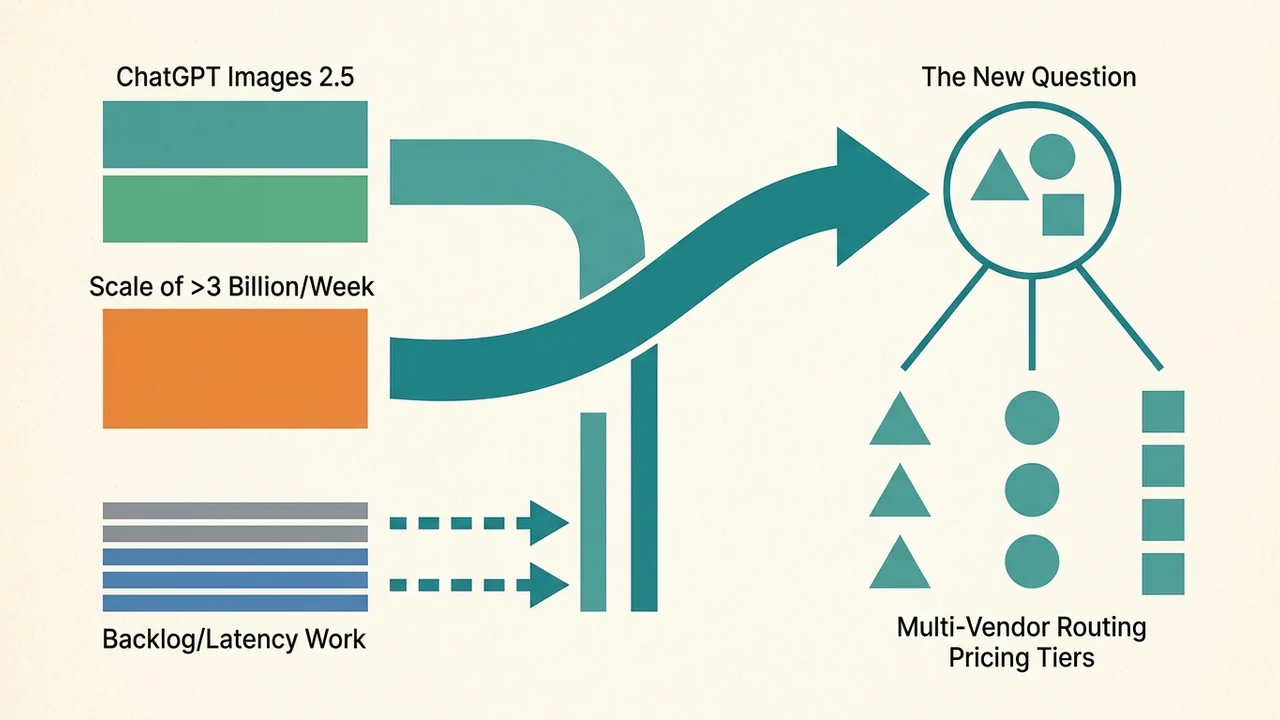
Flare vs Sunburst on the primary provider (OpenAI)
From public launch materials (2026-09-08):
- Flare — default for everyday / high-volume generation; OpenAI cites up to ~50% lower latency vs Images 2.0.
- Sunburst — precision-heavy creative and editing; longer generation time.
Flare and Sunburst share identical token list pricing ($5/M text in, $8/M image in, $30/M image out on official pricing). Choose speed vs edit fidelity, not a cheaper model ID.
For Bubble apps:
- Route bulk text-to-image to Flare by default.
- Reserve Sunburst for labeled hero jobs, hard edits, or when Flare fails your acceptance tests—not for every bulk slot.
WaveSpeedAI: when price tables matter
WaveSpeed is a third-party host with four REST paths (Flare/Sunburst × text-to-image/edit), an async predict → poll flow, different parameter names (resolution, aspect_ratio vs OpenAI size, quality), and fixed per-image pricing (e.g. text-to-image medium at 1K at $0.024; Flare and Sunburst match on WaveSpeed’s published table).
They explicitly warn: quality tier names are not 1:1 between GPT Image 2 and 2.5—re-baseline on medium, do not assume preset parity.
WaveSpeed fits when:
- You need predictable COGS per image and burst offload.
- A golden-set proves visual parity at mapped settings (often Flare-only for bulk).
Avoid WaveSpeed when:
- You run multi-turn edit chains—keep one vendor and one pinned snapshot.
- You rely on OpenAI Responses continuity—splitting vendors breaks state.
Routing matrix (high-volume Bubble / inferred BIAIG-style connector)
No public BIAIG docs were in the research packet; treat this as inferred from OpenAI/WaveSpeed guidance. Validate on your connector.
| Scenario | Route | Rationale |
|---|---|---|
| Bulk text-to-image, brand-flex slots | Flare on primary OpenAI | Latency, IPM, single parameter stack |
| Bulk with fixed $/image COGS | WaveSpeed Flare after golden-set | Table pricing; bake poll into workflow |
| Multi-step edits, same subject/background | Single vendor, pinned snapshot e.g. gpt-image-2.5-flare-2026-09-08 |
Same quality label ≠ same visuals across models; test full chains |
| Hero / precision edit | Sunburst, same vendor as follow-up steps | Do not alternate Flare → Sunburst → another host without tests |
| Batch economics | gpt-image-2 Batch in an isolated lane if quality passes |
Different generation—consistency trade-off |
| 2.5 Batch half-rate | Verify before production | Model pages list Batch for 2.5, but public batch pricing/acceptance for 2.5 IDs was unclear in Sept 2026 coverage—do not budget “50% off Flare” without an official batch row |
Consistency checklist (before production routing)
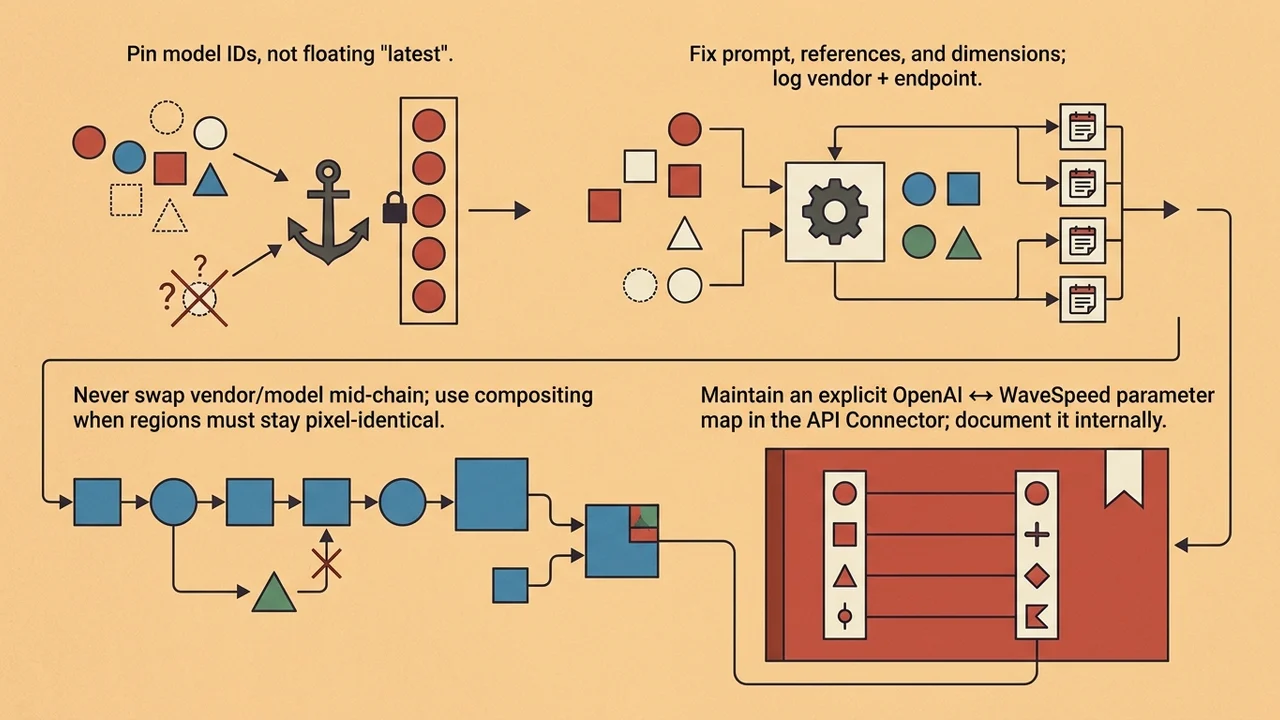
- Pin model IDs (dated snapshots), not floating “latest” in prod.
- Fix prompt, references, dimensions, and quality; log vendor + endpoint per edit step in Bubble.
- Never swap vendor or model mid-chain; use compositing when regions must stay pixel-identical (per OpenAI image prompting guidance).
- Maintain an explicit OpenAI ↔ WaveSpeed parameter map in the API Connector; document it internally.
- Run your golden-set on primary vs WaveSpeed at mapped tiers (start at
medium). - IPM/TPM may force queues or offload—routing is not price-only; do not mix vendors inside one edit thread.
- OpenAI org verification for GPT Image; review third-party retention, region, and policy separately. Worth reading next: OpenAI Decisions API (preview): classification. A closer look: bubble.io reviews for founders: a.
Open questions (do not fake answers in COGS models)
- Whether
/v1/batchaccepts 2.5 flare/sunburst with documented half-rate pricing. - Whether WaveSpeed runs equivalent weights/snapshots and moderation vs direct OpenAI.
- Break-even between OpenAI token billing and WaveSpeed $/image for your quality/resolution mix—requires your calculator and measurements.
Bottom line
Flare is the default bulk lane on primary OpenAI; Sunburst is a narrow premium for edit-heavy work; WaveSpeed is optional predictable COGS after parity proof—not a drop-in for multi-turn chains. Consistency beats a cent per image—design vendor boundaries as carefully as you design async and batch.