Qwen-Image-2.1 vs closed models: vendor benchmarks and production validation for Bubble bulk catalogs
Qwen-Image-2.1 weights dropped 2026-09-20, but a leaderboard row does not prove your SKU batch survives production. What to verify, how to A/B providers with fixed prompts via BIAIG batch, and why Qwen Research License is a separate gate for paid Bubble apps.
Why now
The digest flagged Qwen vendor benchmark claims against closed models with independent tests still pending. The “cheaper/better” narrative is forming before teams lock a provider for a year. For Bubble developers running bulk catalogs (hundreds of rows, shared prompt rules), the question is not who tops a slide—it is per-SKU consistency, failure rates, and alpha usability on your inventory. Worth reading next: gpt-image-1 sunsets 23 Oct 2026:. A closer look: SenseNova U1 Pro and 8K. A closer look: AI coding for Bubble builders:. A closer look: ComfyUI 0.40 and Qwen-Image 2.1.
What shipped (Scout-bound facts)
Qwen-Image-2.1 (2026-09-20): unified text-to-image and image-editing; visual generator described as 7B (32 single-stream DiT layers), native RGBA, up to 10 reference images, local edits, ~2K aspect presets. Weights and code on GitHub / Hugging Face / ModelScope; day-zero integrations cited for Diffusers, ComfyUI, vLLM-Omni, SGLang.
License: Qwen Research License—not Apache 2.0 like earlier Qwen-Image releases. README and Hugging Face model cards state commercial deployment requires a separate commercial license. That is a hard stop for monetized Bubble apps and client work, not a footnote.
Ops footprint: “7B” is not the full stack; secondary production notes cite roughly ~33GB BF16 (generator + Qwen3-VL 8B + VAE). Open weights do not automatically mean lower cost until you model your batch.
Vendor benchmarks: useful signal, wrong decision metric
Quality positioning relies on Qwen-Image-Bench (~1k bilingual prompts, 56 facets, five L1 pillars) scored with Q-Judger (open toolkit on GitHub / arXiv). Reproducible, but still vendor-in-vendor evaluation. Public independent preference arenas scanned around late Sep 2026 listed other Qwen SKUs on Artificial Analysis—not Qwen-Image-2.1—consistent with “independent tests pending.”
Third-party summaries of the launch chart place Qwen-Image-2.1 at ~60.28 overall—first among listed open-weight models, below six closed models (top cited: GPT Image 2.5 Sunburst ~67.01) and below Qwen Image 3 Pro (~62.36). Margins vs named rivals are often under one point; ordering is fragile across API settings and optional rewriters.
Bubble takeaway: headlines about “beating closed models” depend on framing—six closed models still sit above 2.1 on the same chart. Until someone reproduces the row on the same prompts, steps, resolution, and rewriter settings, treat chart order as vendor narrative, not production approval.
Benchmark slide ≠ bulk catalog consistency
Aggregate scores do not measure:
- variance row-to-row with identical prompt templates;
- retries and timeouts across 500+ workflow items;
- RGBA QA (halos, compression, CDN/browser behavior in Bubble frontends);
- packaging text legibility and brand fidelity on your SKUs.
Production validation should freeze prompts (and control optional PE-T2I / PE-I2I rewrite behavior in A/B), hold seeds / steps / resolution constant, run the same SKU/prompt batch, and compare providers on pass rates, not a single hero render.
Claim checklist on your SKU set
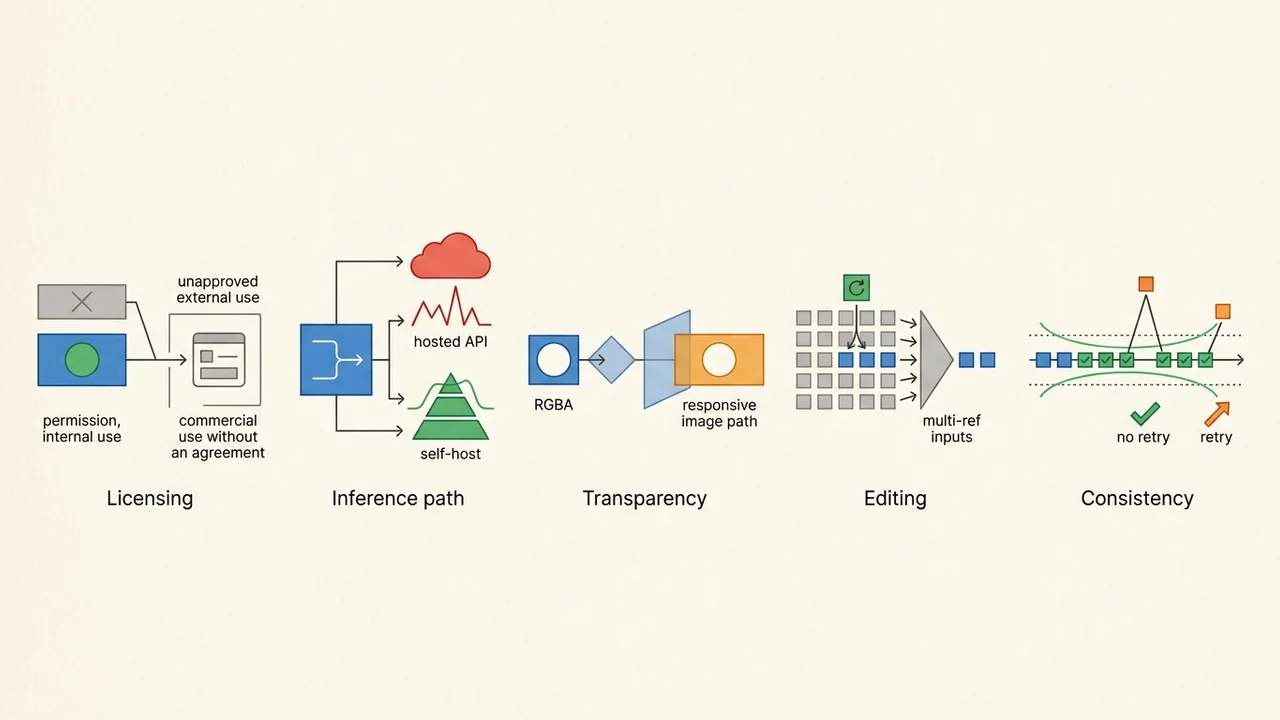
- Licensing — is commercial use allowed for your Bubble app without a separate agreement?
- Inference path — self-host vs hosted API: latency, SLA, cost at your batch size.
- Transparency — does native RGBA survive your export → storage → responsive image path?
- Editing — do local edits and multi-ref inputs cut manual rework on bad rows?
- Consistency — % rows without retry, deviation from reference, blind review on a random sample (e.g. 30 SKUs × 3 seeds).
Use digest claims only as hypotheses until this checklist passes on your catalog.
A/B via BIAIG batch without changing prompts
The editorial brief references an in-house BIAIG batch pattern: one batch run, the same stored Bubble prompts, only the provider / model endpoint changes. Scout found no public BIAIG documentation—treat it as an internal workflow, not an external spec.
Minimum A/B discipline:
- Frozen prompt table — no “helpful” rewrites between arms;
- Rewriter control — if the Qwen route enables official prompt rewrite, mirror on/off rules for the closed arm or split cohorts explicitly;
- Identical render params — resolution, steps, aspect presets from your catalog rules;
- Paired SKU keys — match on
product_id, not lookalike products; - Metrics — rubric pass/fail (fidelity, text, alpha clean, brand color), not bench aggregates.
Output should be a provider × failure mode table you can defend to clients without hype.
Open questions (leave them open)
- Has anyone reproduced the launch leaderboard row using Qwen-Image-Bench prompts + Q-Judger on the same closed APIs and settings?
- When will 2.1 appear on independent arenas, and how will Elo relate to Bench totals?
- Published commercial license terms, pricing, and SLA for hosted Qwen vs self-host at your volume?
- Does optional PE rewriting materially change outcomes vs raw Bubble-stored prompts?
Bottom line
Qwen-Image-2.1 is a credible open-weight option for RGBA and unified editing, but vendor benchmarks + Q-Judger are not your bulk catalog. Until independent tests and SKU-level A/B (BIAIG batch, fixed prompts) land, do not lock a year-long provider based on a slide. License first, then pass rate on N SKUs.
Sources: Scout packet (Qwen-Image-2.1 README, Hugging Face model card, Alibaba Cloud launch post, Qwen-Image-Bench paper/repo, Artificial Analysis arena snapshot, secondary summaries). Not for external publication.