Qwen-Image-2.1 open source: RGBA, 10 refs, and research license — what is realistic for Bubble bulk via BIAIG
Alibaba shipped Qwen-Image-2.1 (7B, native RGBA, up to 10 refs) under the Qwen Research License. For paid Bubble catalog/ad bulk, it is not a drop-in closed-API replacement until commercial rights or an acceptable hosted SKU exist.
Context
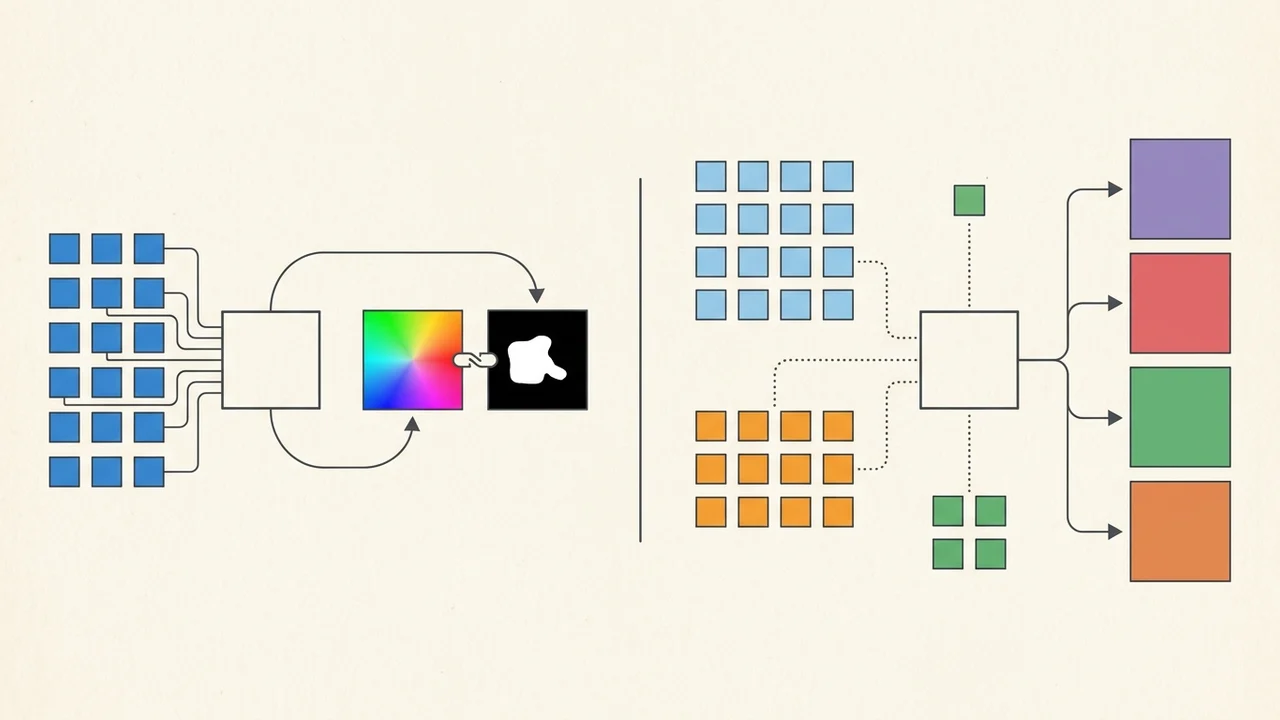
The digest flagged Qwen-Image-2.1 (2026-09-20): downloadable weights on GitHub, Hugging Face, and ModelScope—a unified text-to-image and image-editing pipeline with a 7B DiT, Qwen3-VL 8B encoder, and a 64-channel RGBA VAE. Documented capabilities include native RGBA (prompt-guided), up to 10 reference images per edit/composition call, local edits via masks/annotations, ~2K aspect-ratio presets, 40 default inference steps, and optional prompt rewriters (PE-T2I / PE-I2I). Day-0 integrations include Diffusers (QwenImage21Pipeline), ComfyUI, vLLM-Omni, and SGLang.
The Bubble developer question is blunt: is this an alternative to closed APIs for catalog/ad variants? For production bulk via BIAIG, self-hosting is technically feasible, but the legal/compliance gate comes before GPU sizing. Same topic: Qwen-Image-2.1 before 28.09 UTC+8: freeze. A closer look: ComfyUI 0.40 and Qwen-Image 2.1. Same topic: Qwen-Image-2.1 before 28.09 UTC+8: freeze.
Research license is the headline
Weights ship under the Qwen Research License Agreement (effective 2026-09-20): use, modification, and redistribution are non-commercial only; commercial use requires a separate license (LICENSE points to [email protected]). Redistribution and derivatives carry notice, modification marking, possible “Built with Qwen” / “Improved using Qwen” attribution, and explicit export-control obligations.
Using public weights for revenue-generating Bubble catalog/ad bulk without a commercial license is a material legal risk in the Scout packet—not a “we’ll figure out licensing later” ops detail. POC, internal R&D, and non-monetized demos are a different bucket; client-facing paid bulk is not, until rights are formalized. Worth reading next: Meta Muse Image on fal.
Self-host: what ops actually means
The README describes full-stack inference (7B + 8B VL + VAE). Published VRAM guidance varies: framework docs with VRAM management cite on the order of ~7GB minimum; independent setup guides often assume ~16–24GB-class GPUs for typical int8/bf16 paths; component downloads land in a ~15–30GB class. Bulk throughput depends on serving (single-GPU Diffusers vs vLLM/SGLang batching), optional prompt rewrite, and 2K/40-step defaults—no vendor-neutral bulk SLA was found.
“Wire Qwen directly into Bubble” is not one API Connector call—it is GPU capacity, serving, monitoring, patching, plus a possible second inference stage for PE rewrite.
RGBA and 10 refs vs existing orchestration
Qwen-Image-2.1 (model docs):
- hard cap of 10 reference images per call;
- native RGBA generation/editing in-model (64-channel VAE).
Comparison from primary API docs only (not BIAIG-specific):
- OpenAI GPT Image
images/editssupports up to 16 input images; RGBA in the API is emphasized for masks (alpha), not as native transparent output in the same sense as Qwen’s README. - Google Gemini 3.x image models document up to 14 reference images with role splits (e.g., gemini-3.1-flash-image: up to 10 object + 4 character refs); native RGBA-as-output is not described equivalently on those pages.
Fal and other aggregators were not verified in this Scout pass.
For multi-asset catalog compositions, 10 refs may be a bottleneck vs 16 (OpenAI edit) or 14 (Gemini). Native RGBA matters when transparency is part of the product contract, not an afterthought—but no neutral A/B vs background removal in existing BIAIG/GPT/Gemini pipelines was found; do not sell RGBA as a win without your own measurement.
Hosted API path for 2.1
QwenCloud’s Images FAQ (context 2026-09-22) lists qwen-image-2.0 / 3.0 family models with per-image billing; Qwen-Image-2.1 is not listed by name in the excerpt reviewed—no verified self-serve DashScope SKU for 2.1. HF demos, ModelScope Civision, and wuli.art do not substitute for production licensing terms. Same topic: Qwen-Image-2.1 vs closed models: vendor. Same topic: Qwen-Image-2.1 vs closed models: vendor.
When to stay on BIAIG over GPT Image 2.5 / Gemini / fal
This piece does not repeat GPT Image 2.5 ref checklists or the “Gemini as third provider” article; it maps where Qwen-2.1 fits.
Stay on BIAIG orchestration over commercial APIs when you need:
- production rights and SLAs today;
- bulk already tuned on GPT Image / Gemini / fal with your retries, QA, and ref roles;
- compositions that need more than 10 refs or mixed providers;
- no appetite to run self-hosted diffusion ops.
Qwen-Image-2.1 is a fit as:
- research / POC (transparency experiments, 10-ref edits, local eval);
- a future licensed backend after (1) commercial license or hosted API with acceptable ToS/pricing, (2) measured throughput/cost on your serving stack, (3) product integration in BIAIG (whether BIAIG already abstracts self-hosted backends was not in public Scout scope).
Direct Qwen hookup becomes realistic after explicit commercial licensing or a hosted SKU—as an engineering track, not a single API key swap driven by digest hype.
Benchmarks—handle carefully
Alibaba Cloud Community references Qwen-Image-Bench; secondary press mentions scores around ~60.28—methodology and independent replication were not verified. Do not roadmap on bench “wins” without eval on your catalog/ad tasks.
Decision checklist
- Legal: commercial license or clear hosted ToS before any paid bulk.
- Product: do 10 refs + RGBA cover your variant matrix, or is 14–16 ref orchestration cheaper in rework?
- Ops: measured latency and failure rates on vLLM/SGLang vs managed APIs near 10 refs.
- Compliance: export controls and attribution if you fine-tune or embed weights.
Open questions (from Scout)
Published commercial license pricing; whether 2.1 lands on DashScope like 2.0/3.0; whether the research license restricts customer-facing outputs vs weights alone—qualified legal review needed; bulk economics at 2K/40 steps; RGBA fidelity vs post-process in your pipelines.
Sources: Qwen-Image-2.1 GitHub README, Hugging Face LICENSE/model card, Alibaba Cloud Community post, QwenCloud Images FAQ, OpenAI/Gemini image API docs, DiffSynth-Studio framework doc; secondary—LaoZhang blog, GadgetsNow press. Not legal advice.