Midjourney litigation 2026: vendor risk and fallback routing for bulk images in Bubble
Consolidated Disney/Universal and Warner Bros. Discovery suits against Midjourney are an operational signal for Bubble teams running bulk image jobs: primary/secondary routes, per-output model metadata, and multi-provider orchestration reduce lock-in—they are not a substitute for legal review.
Why it matters now
A recent digest cited a Rule 12(c) hearing on September 28, 2026; the authoritative date from the lead docket is October 26, 2026, 8:30 a.m. (Courtroom 10C, Judge Kronstadt), per the joint stipulation order filed July 23, 2026 (Lead Case Dkt. 143). The consolidated action is Disney Enterprises Inc. et al. v. Midjourney Inc., 2:25-cv-05275 (C.D. Cal.), following Disney/Universal (filed June 11, 2025) and Warner Bros. Entertainment Inc. et al. (September 4, 2025, reported by Reuters). If your Bubble app drives bulk image generation through APIs, the signal is operational uncertainty—service continuity, ToS/guardrails, API access—not model quality alone. Litigation is active (e.g., magistrate discovery ruling Dkt. 88, June 15, 2026). A closer look: China VPS and downstream liability. A closer look: China VPS and downstream liability.
Not legal advice. Filings are allegations; no public finding of liability for Midjourney or its customers. Fallback routing is resilience, not a compliance guarantee.
Facts this article rests on
- Major U.S. studios sued for direct and secondary copyright infringement under 17 U.S.C. § 501; cases consolidated November 5, 2025; lead docket 2:25-cv-05275.
- Midjourney moved for partial judgment on the pleadings under Fed. R. Civ. P. 12(c) to dismiss contributory infringement in the “Second Claim for Relief,” citing Cox Communications, Inc. v. Sony Music Entertainment, No. 24-171 (U.S. March 25, 2026): contributory liability requires intent that the service be used for infringement—via inducement or a service tailored to infringement.
- Plaintiffs’ opposition: secondary liability is also pled on inducement and vicarious liability; they argue the motion cannot wipe the full secondary claim if it only targets inducement.
- Briefing deadlines (Dkt. 143): opposition by August 11, 2026; reply by August 25, 2026.
Operational plan for Bubble (bulk images)
1. Primary and secondary routes
Define two independent generation paths in your workflow: A closer look: Meta @-reference removal: migrating ref. Worth reading next: ByteDance–MPA guardrails on Seedream/Seedance: bulk.
| Role | Purpose |
|---|---|
| Primary | Default vendor (e.g., Midjourney via your connector) for the happy path |
| Secondary | Different provider/model via a separate API call—enabled before an incident |
Bubble practice:
- One backend workflow “Generate image” with
route: primary | secondary | auto-failover. - Auto-failover: on primary timeout, 429, 5xx, or policy errors—one retry on secondary; log the switch reason (no silent fallback).
- Avoid hardcoding a single vendor across repeating groups, emails, and scheduled bulk jobs; store provider config in option sets or a custom type
ImageProvider(name, endpoint, api_version, enabled).
2. Document model/vendor source on every output
Persist immutable metadata at write time for each generated asset:
vendor(product/legal name)model_or_plan(as returned/named by the API)api_version/ endpoint idgenerated_at(UTC)workflow_run_id/ Bubble unique idroute_used(primary | secondary | failover)- prompt handling per your retention policy (hash or truncated store)
When ToS change, you run internal review, or you re-batch assets, you know which stack produced each file.
3. Multi-provider orchestration (BIAIG as a pattern)
The approved angle names internal BIAIG orchestration. Public court sources did not verify BIAIG product details—treat this as an architecture pattern to validate internally:
- Router layer (API Connector or backend): normalize requests (size, aspect ratio, safety flags) and map to provider-specific payloads.
- Single response shape in Bubble (url, id, provider_ref) so the UI stays vendor-agnostic.
- Feature flag to disable vendor X without redeploying every page.
- Quota/cost counters per provider so secondary does not become the expensive default by accident.
That mitigates lock-in and switch time; it does not mean “legally safe” outputs or licensed use of studio characters.
4. What not to promise
- Cox does not resolve direct infringement, fair use, training-data theories, or inducement/vicarious claims in the studio complaints.
- The 12(c) outcome is unknown.
- Fallback routes do not make bulk outputs cleared for commercial character-like use.
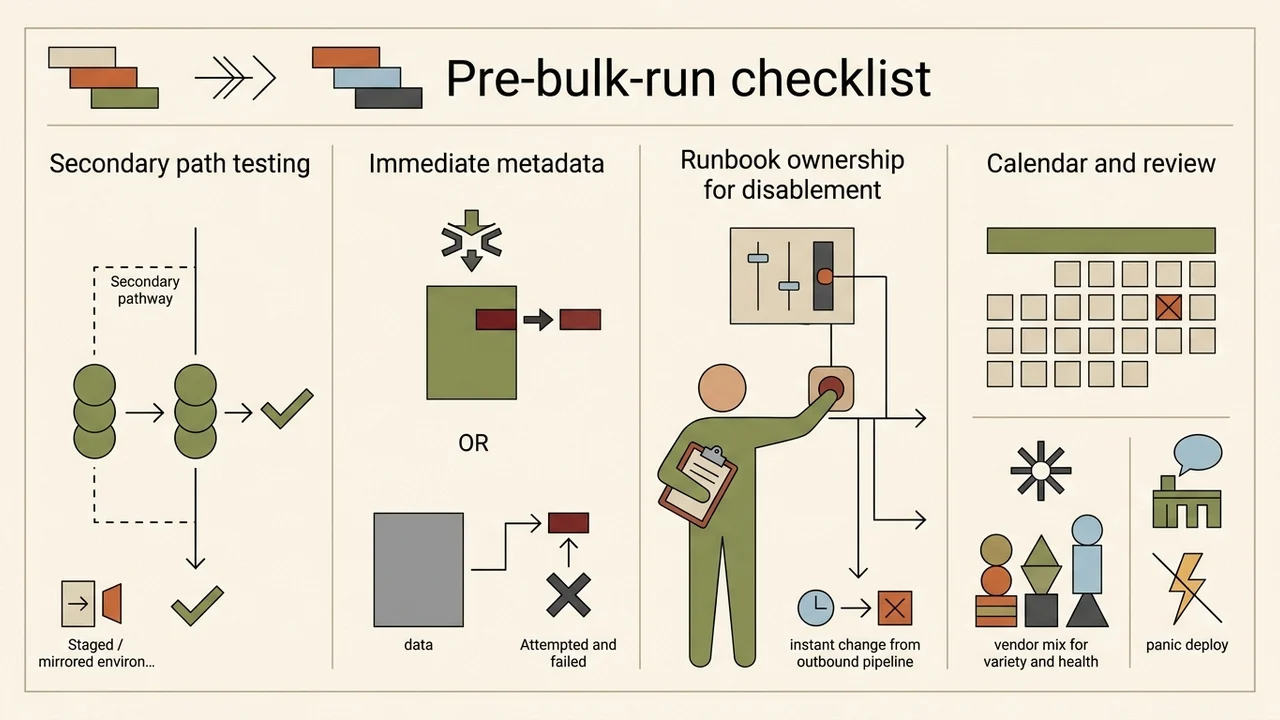
Pre–bulk-run checklist
- Secondary path tested on staging with the same normalized payload.
- Metadata written on create, not patched later.
- Runbook owner for disabling primary within minutes on outage/policy change.
- Calendar: October 26, 2026 hearing—no panic deploy; revisit vendor mix if it has stagnated.
 A closer look: Mixboard offline on 28.09: exporting. A closer look: Mixboard offline on 28.09: exporting.
Sources (public)
CourtListener dockets 2:25-cv-05275 / 2:25-cv-08376; Dkt. 143 (hearing reset); Midjourney Rule 12(c) motion and plaintiffs’ opposition (RECAP); Cox slip opinion (supremecourt.gov); Reuters June 11, 2025 and September 4, 2025; magistrate order Dkt. 88.