ByteDance–MPA guardrails on Seedream/Seedance: bulk yield and retry patterns in Bubble with BIAIG
After the MPA (Motion Picture Association)–ByteDance MOU, guardrail rejects often come from the provider—not Bubble workflows. How to log rejection classes, run bounded retries with policy-safe rephrasing, and use alternate providers in BIAIG without promising 100% yield.
Context for Bubble bulk
Recent digest coverage flagged output guardrails on Seedream and Seedance in the ByteDance–MPA story. Public reporting is clear: MPA means the Motion Picture Association (Hollywood studios trade group), not a “Model Provider Alliance.” In August 2026, the MPA and ByteDance announced an MOU on generative image/video guardrails across TikTok, CapCut, Dreamina, and related surfaces—including lines such as Seedream 5.0 Pro and Seedance 2.5—framed as IP protection after events like a February 2026 cease-and-desist around celebrity likeness and copyrighted characters.
For catalog builders, this is not “a new Bubble plugin moment.” It is an operational yield shift: some jobs never become stored assets because the provider filtered or blocked output, even when the API key is valid and the workflow shows no Bubble-side error. A closer look: Flare, Sunburst, and WaveSpeedAI: routing. A closer look: Flare, Sunburst, and WaveSpeedAI: routing.
What is publicly known about enforcement
Primary announcements (TikTok Newsroom, CapCut Newsroom) describe prompt blocking, content moderation, unauthorized likeness/IP filters, watermarks / C2PA, and reporting. Full technical thresholds are not published; safeguards are described as evolving.
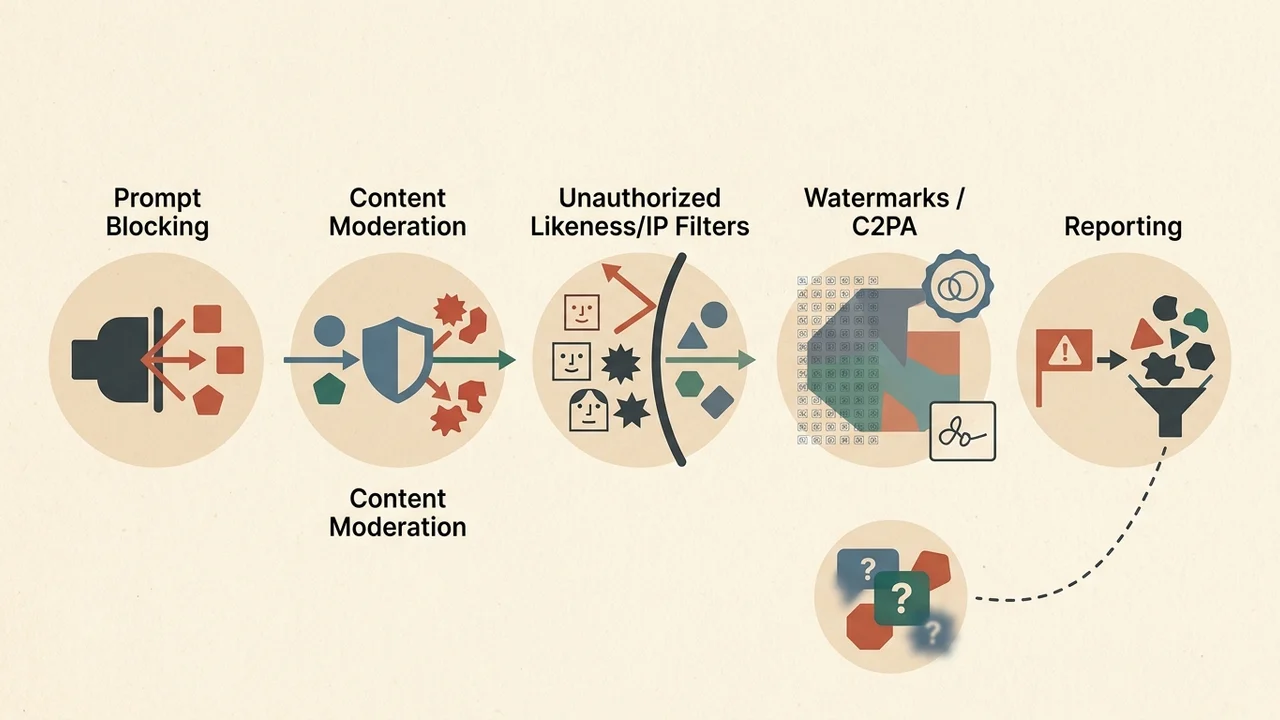
For API integrators, BytePlus ModelArk documents a two-layer stack: input pre-filter plus output moderation. Official guidance: classify rejections using structured error fields, not HTTP status alone.
Third-party reseller guides add operational heuristics—pre-generation vs post-generation failures, stochastic retry variance, IP/celebrity/audio-dialogue triggers. Treat these as hints to validate on live API responses, not contractual facts.
Why HTTP 403 is not enough
Bulk pipelines often log “403” and stall the queue. In practice, 403 can mix moderation blocks, permissions, and billing/balance issues. Guardrail rejects need their own reason class in logs.
Minimum fields per attempt (inferred production pattern):
provider,model,route(BytePlus direct vs proxy/reseller)attempt_index,correlation_id(catalog / SKU / job)- structured
error.code,error.messagefrom the API phase:input_block|output_block|delivery_denied|unknown_moderation|non_moderation- normalized prompt fingerprint (avoid storing PII in plain text if policy requires)
- optional host flags (e.g. documented
safety.checkContent, NSFW on some resellers)—they do not reliably override upstream output policy

Retries: bounded, policy-compliant—not evasion
Public documentation does not support promising 100% bulk yield. Identical prompts can intermittently fail at the output stage.
Practical retry policy for BIAIG (Bubble-side AI generation orchestration—internal stack label; not a public standard product name): A closer look: China VPS and downstream liability. A closer look: China VPS and downstream liability.
- Classify the failure: input vs output vs non-moderation.
- Non-moderation (auth, quota, timeout): backoff, quota/route fixes, support—do not “rewrite prompt” as the primary fix.
- Moderation: capped budget (e.g. one–two rephrases plus one alternate model) with safe rephrasing:
- remove real-person names, brands, named characters, “in the style of [celebrity]”;
- replace with generic descriptors (wardrobe, composition, lighting, mood);
- for video, treat dialogue/audio prompts cautiously (often cited in third-party guides as triggers).
- Do not automate aggressive rewrites that look like policy evasion—AUP and client trust risk.
- After budget exhaustion: terminal reject with reason class for QA and client reporting.
Alternate provider in BIAIG
When Seedream/Seedance consistently reject a prompt class (e.g. character-adjacent catalog copy), bulk needs a fallback graph: another approved provider/model in the same BIAIG orchestration layer, using the same logging schema. Worth reading next: OpenAI Decisions API (preview): classification. Worth reading next: OpenAI Decisions API (preview): classification.
Optional host-level safety toggles on some resellers do not guarantee success when upstream output policy is terminal—plan for sub-100% yield in client-facing expectations.
Transparency for catalog clients
Without “we will generate 100% of SKUs” promises:
- report attempt counts, success rate, and aggregated reject reason classes;
- show how many items need human prompt rewrite or manual assets;
- note that post–Aug 2026 MOU guardrails may affect IP and likeness categories for style/character-adjacent prompts—exact delta on your API route remains an open question without internal metrics.
Pre–bulk-run checklist
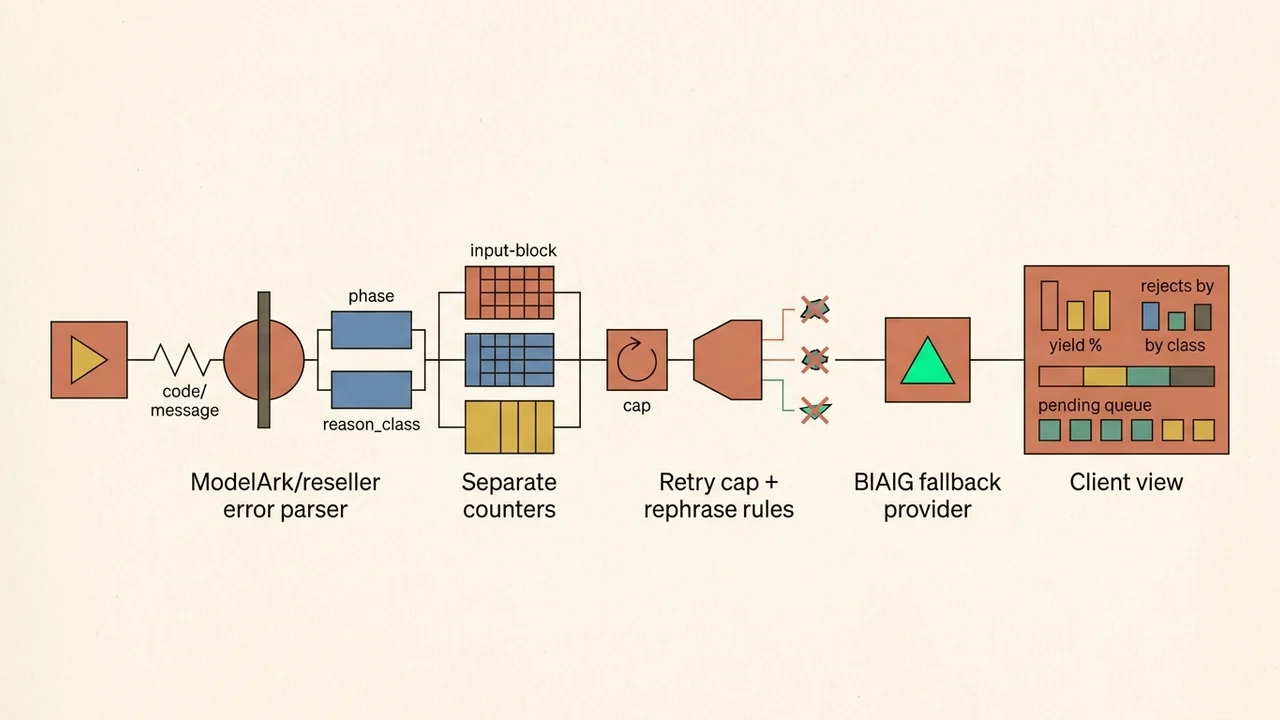
- ModelArk/reseller error parser: code/message →
phase+reason_class - Separate counters for input_block vs output_block vs billing
- Retry cap + allowlisted rephrase rules (no celebrity/brand tokens)
- BIAIG fallback provider for terminal moderation
- Client view: yield %, rejects by class, pending rewrite queue
Sources (evidence tier)
Primary (policy intent): TikTok Newsroom (MPA–ByteDance MOU); CapCut Newsroom (Seedance 2.5 / Seedream 5.0 Pro); BytePlus FAQ and ModelArk content pre-filter documentation.
Secondary (context): Variety; The Next Web.
Operational hints (verify live): Segmind error guide; Runware / ReAPI docs on host safety flags.
BIAIG and Bubble workflow recommendations are inferred production patterns until verified against your endpoint responses.