OpenArt Bulk Create (500 CSV prompts) vs BIAIG: where to run catalog bulk inside Bubble
Spreadsheet batches like OpenArt (~500 rows) and Bubble-native bulk via chunking answer different constraint stacks. A criteria matrix for when to stay on Bubble+BIAIG vs exporting CSV to external SaaS and ingesting assets back.
Why this shows up now
The digest highlighted OpenArt Bulk Create: upload a .csv or .txt of prompts and generate up to 500 images in one batch (per OpenArt’s changelog, announced June 17, 2024). That is the same job family as catalog bulk in Bubble—many SKUs, one prompt per row, async “check back later.” Worth reading next: Fragmented bulk-tools niche: Apify spreadsheet. A closer look: The ~500-row bulk-tools ceiling in. Same topic: Magnific One (Brand Kit +. A closer look: ChatGPT virtual try-on and shopping. A closer look: ChatGPT is not bulk-native: where.
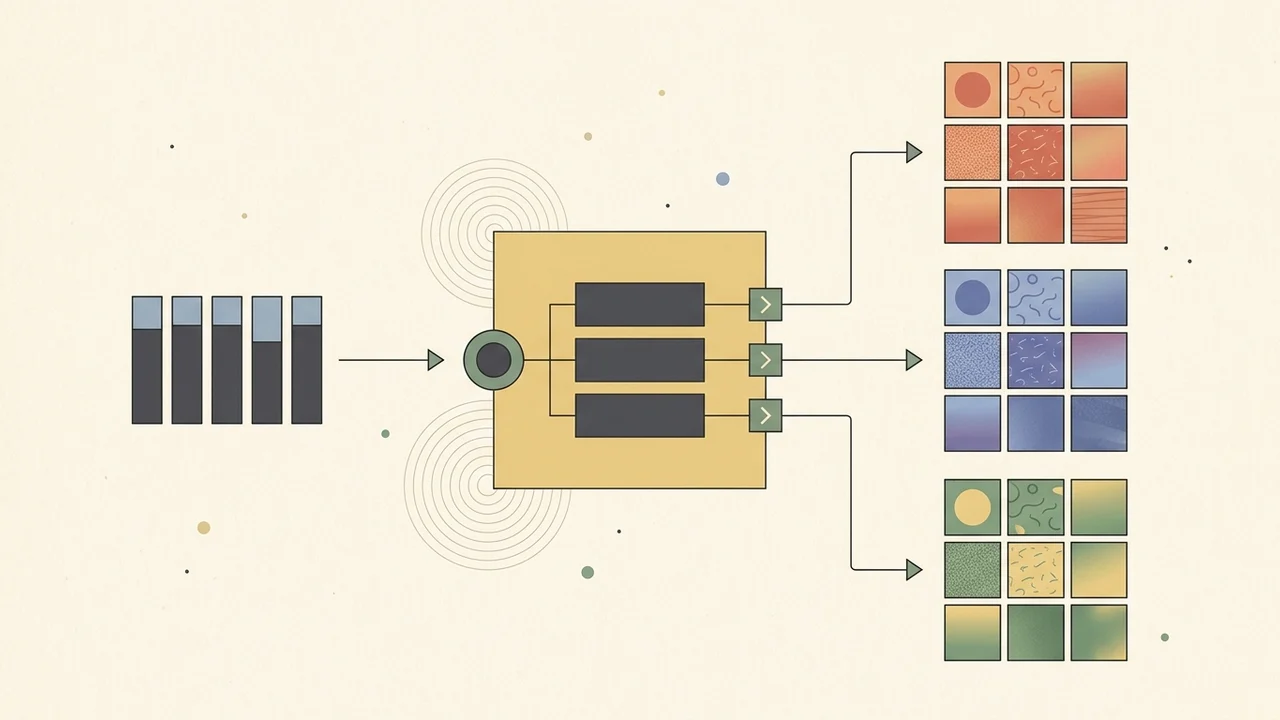
Wireflow’s September 2026 roundup is useful only as category framing (not as rankings). It separates three bulk jobs: Worth reading next: gpt-image-1 sunsets 23 Oct 2026:.
- Many distinct prompts from a sheet (OpenArt, Ideogram).
- Template/data-merge graphics.
- Programmatic/API volume (REST, polling, webhooks).
OpenArt’s web flow sits in (1). The OpenArt CLI (September 2026 guide) extends into (3): async jobs, optional per-row model/dimensions in CSV, JSON polling—but you still own job ID ↔ prompt ↔ download URL mapping.
Ideogram Batch Generation is a peer pattern: up to 500 prompt rows plus header, ≤1 MB, richer per-row columns; Pro/Team and Priority credits. Compare batch ceilings, not “Bubble replacement.”
Bubble-native: a different constraint stack
Catalog bulk in Bubble is usually orchestration, not one upload action:
- Editor CSV upload — forum threads often cite plan-based row caps (~100 / ~200 / ~1000 for Personal / Professional / Production). Treat these as community-reported; confirm in your plan UI before hard-coding.
- Bulk Data API — third-party docs (CSVBox) cite up to 1,000 items per bulk create/update request—a different path from a single CSV action.
- Schedule API workflow on a list — the manual describes scheduling over large lists (on the order of ~100,000 items cited in excerpts). Established pattern: split CSVs, create/import Things, schedule backend workflows per row or chunk.
~500-row SaaS batches and ~500-row Bubble chunks are an analogy, not equivalence: SaaS caps are product batch sizes; Bubble limits are import, API payload, and provider rate limits.
BIAIG (internal stack context)
Scout did not find a public product page tying “BIAIG” to authoritative docs. Until you supply primary BIAIG/Bubble documentation, treat these as editorial stack assumptions:
- Catalog data, app roles/privacy, and audit trails belong in Bubble (or your S3 with policies tied to app users).
- Multi-provider / per-row model routing fits Bubble + API Connector + backend workflows better than a single-model browser batch.
- Metadata at generation time (IPTC-like, merchant fields) needs a schema spreadsheet SaaS may not honor without custom post-processing.
Decision matrix (criteria, not scores)
| Criterion | Lean Bubble (+ BIAIG/orchestration) | Lean external CSV batch (OpenArt/Ideogram/…), then ingest |
|---|---|---|
| Where assets live & access control | App roles, per-item ownership, DB audit | Temporary SaaS gallery OK if Bubble re-applies privacy on ingest |
| Retrieval | Automated webhook/API in backend workflows | Manual gallery download OK, or OpenArt CLI with strict mapping discipline |
| Model per row | Multiple providers/models per row | Single provider/model per web batch, or CLI CSV columns |
| Catalog metadata | Merchant/IPTC fields on Things before publish | Metadata added after download (mapping error risk) |
| Operational chunk size | Bubble CSV/API chunks + scheduled lists | ~500-row SaaS batch; row multiplication for multiple images per prompt (community OpenArt workflow) |
| Cost model | Per-generation API + Bubble compute | SaaS credits/subscription; price the full path (batch + ingest + storage) |
| Compliance / prompts | Prompts must not leave Bubble | Third-party ToS/residency acceptable; prompts in vendor queue |
Wireflow contrasts OpenArt’s high browser batch volume with weak programmatic retrieval (“gallery, download by hand”) vs canvas+REST pipelines. That is an operational point—missed assets, wrong prompt-to-file pairs—unless CLI/API ingestion is enforced.
OpenArt CLI warns about rate limits when submitting large batches quickly; a naive fast-loop Bubble backend can hit the same wall.
Practical scenarios
Stay in Bubble (chunking + scheduled API workflows) when:
- The catalog is core product state with privacy rules and merchant fields on each Thing.
- You need multi-provider routing or post-gen steps (resize, watermark, dedupe) in one auditable chain.
- Ingestion must be automatic (URL →
:saved to S3/ file field) with your dedupe or scan rules.
Export CSV to OpenArt (or Ideogram) batch when:
- You need a creative burst: hundreds of distinct prompts, one model, minimal in-app catalog logic.
- The team accepts async work and has an SOP—CLI or job-ID log, not ad-hoc gallery clicks.
- After batch, you have a clear ingest contract back into Bubble (signed URLs,
sku_idcolumn, count verification).
Hybrid (common in digest-style workflows): prompts and SKU ids prepared in Bubble → CSV export → external batch → backend workflow consumes JSON/URLs (CLI pattern) → create/update Things, files, metadata.
Verify before you commit
- Your Bubble plan and import path (editor CSV vs Data API vs in-app upload)—current row/chunk limits.
- Whether metadata is required at generation time or only after ingest.
- Single-provider batch vs per-row model (OpenArt web vs CLI CSV vs Bubble orchestration).
- Whether prompts are sensitive (PII, unreleased products)—external SaaS may be a non-starter regardless of the 500-row convenience.
- Current OpenArt Bulk Create product page (a marketing URL returned 404 during Scout fetch)—confirm cap and tiers in vendor UI.
Sources (from Scout packet)
- OpenArt changelog — Bulk Create, up to 500 images from
.csv/.txt. - OpenArt CLI guide — programmatic batch, CSV columns, polling, catalog-scale cases.
- Ideogram docs — Batch Generation, ~500 rows.
- Wireflow blog/features — three bulk job types; manual vs programmatic retrieval.
- Bubble Forum — CSV row workarounds; Manual — schedule API workflow on a list; CSVBox — Data API 1,000 items (third-party).
Internal editorial draft—do not publish externally without BIAIG fact-check and current Bubble plan limits.