Gemini pricing on 28 Oct after the NB2 cutover (29 Oct): replanning Bubble catalog bulk jobs in BIAIG on Nano Banana 2.1
After I switched the model ID to `gemini-nano-banana-2.1`, I replanned more than per-image dollars: input tokens, batch vs sync, chunks for Bubble Data API limits, and WU—without treating an unconfirmed NB2 shutdown date as fact.
Why replan now
My editorial calendar has 29 Oct 2026 as cutover day from Nano Banana 2 (gemini-3.1-flash-image) to Nano Banana 2.1 (gemini-nano-banana-2.1) through BIAIG—Bubble + Gemini orchestration for catalog bulk jobs. I checked Google’s public pages on 29 Oct 2026 UTC: the deprecations table and release notes still say no shutdown date announced for NB2. Third parties (liteLLM, press) cite 29 Oct. For production I treat that as a reason to probe the live endpoint, not to budget from a digest headline alone. A closer look: Nano Banana 2.1: reported ~50%.
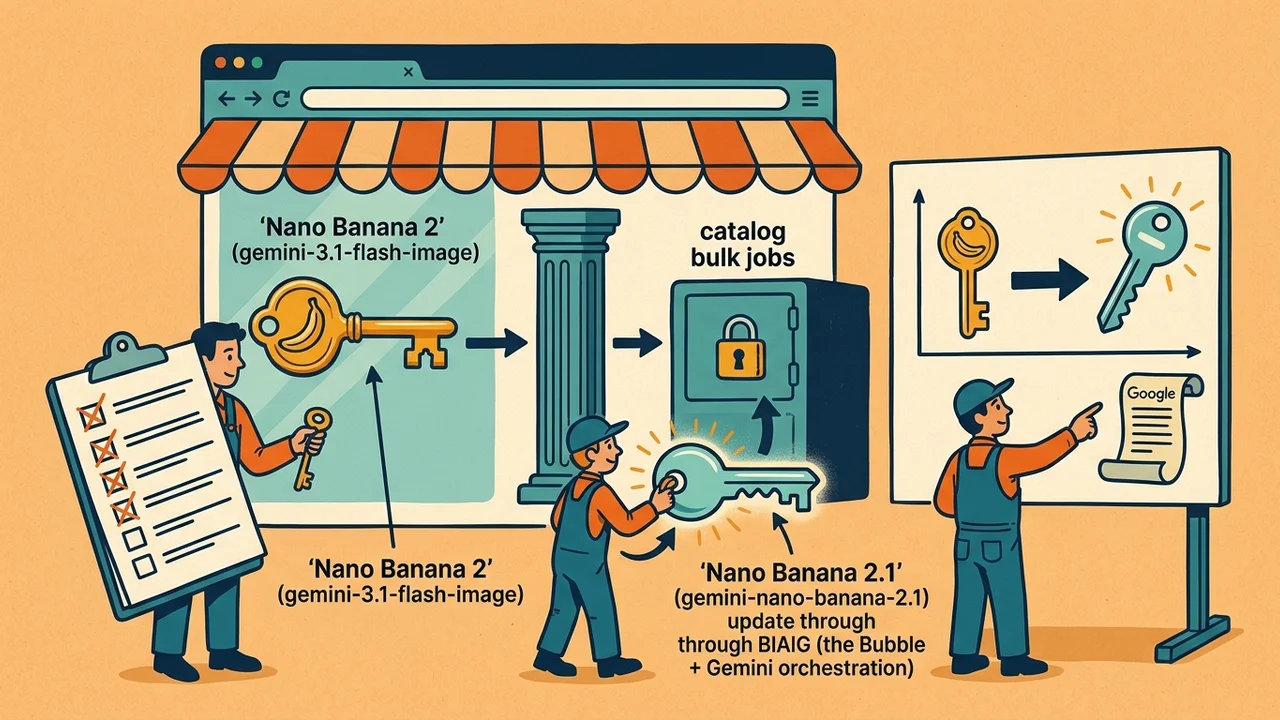
I read the digest line “Gemini API pricing updated 28 Oct” against what actually changed: a third-party diff on 28 Oct is navigation-only (API CLI link), with no numeric rate changes; 27 Oct added billing copy that thinking tokens and grounding-related internal tokens count toward billable usage. The math below comes from the live Gemini Developer API pricing tables, not the headline.
Model delta (what matters for catalogs)
| Item | NB2 | NB2.1 |
|---|---|---|
| Model ID | gemini-3.1-flash-image |
gemini-nano-banana-2.1 (GA 6 Oct 2026) |
| 512px (0.5K) | supported | removed — floor 1K |
| Batch | yes (−50% vs Standard) | yes; ~24h SLO, often faster |
If your pipeline still assumed 512px thumbnails, replan hits storage, CDN, and token math—not just swapping the model string in BIAIG.
Dollar math: cheaper 1K output, expensive input
At 1K image output (pricing-page equivalents):
- Standard: NB2.1 $0.0336 vs NB2 $0.067 per image.
- Batch: $0.0168 vs $0.034 (Batch API—still 50% of interactive).
Input (Standard, $/1M tokens): $0.50 → $1.50 (3×). Batch input: $0.25 → $0.75. Prompt-heavy jobs, reference images, multimodal ingest—you cannot plan from “$ per 1K image” alone. I learned that the hard way on spreadsheets that only tracked output.
4K token counts differ by model (Scout packet example: 3780 vs 2520 tokens). I refresh BIAIG cost maps after the ID change; aggregator mirrors often lag Google.
Grounding / thinking: separate tariff lines; Oct 27 pricing text makes thinking and grounding internals billable. If NB2.1 runs higher thinking levels or search grounding in production, those lines show up in the bill in ways that are easy to miss.
Batch vs sync for Bubble-scale catalogs
Batch (docs): half interactive price, JSONL for large image batches, 20MB inline cap, 2GB per input file—what I use for non-urgent catalog image generation.
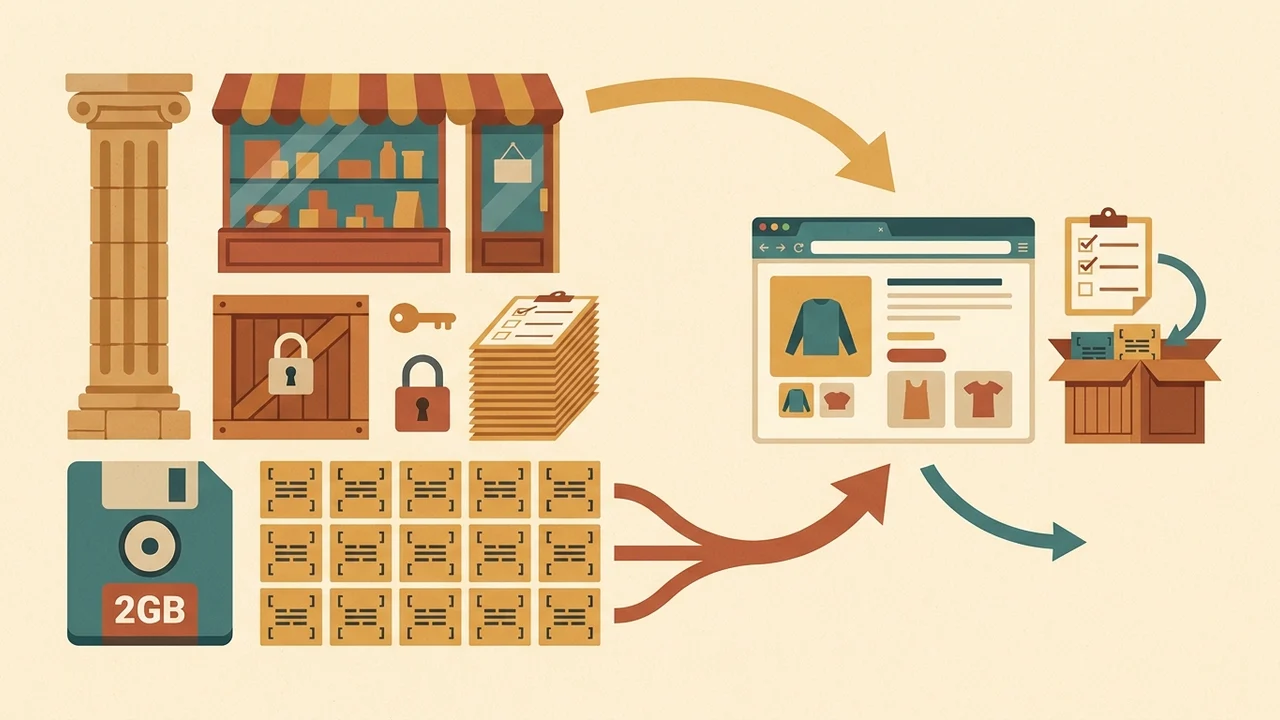
Sync: I keep it for latency-bound flows (previews, same-day merchandising).
Open question from Scout work: does your image path go through generateContent (batch-eligible per batch docs) or the Interactions API? That answer decides whether batch fits BIAIG without a refactor.
Chunk size and WU: dual ceilings
Bubble Data API bulk create: max 1,000 items per POST …/bulk, 4-minute completion limit (manual).
Workload units (activity types):
- ~0.1 WU per scheduled API workflow;
- ~0.6 WU per server workflow action;
- ~0.1 WU per outbound external API call.
I prefer Schedule API workflow on a list over recursive scheduling. Bubble’s informal benchmark is ~12k vs ~70k WU to schedule 100k workflows (comparison). One Gemini call per SKU plus recursive scheduling burns WU fast.
My BIAIG replan sums Gemini $ (input + output + options) + Bubble WU + SLA (batch up to ~24h).
BIAIG replan checklist
- Model ID: configs, env, cost maps →
gemini-nano-banana-2.1; fix gateway-prefixed IDs if billing goes through an aggregator. - Live probe: whether NB2 still responds; explicit fallback if Google keeps “no shutdown date.”
- Resolution: drop 0.5K; reload 1K/2K/4K rows from pricing.
- Cost sheet: Standard vs Batch columns; input $/Mtok for heavy prompts; grounding/thinking as separate lines.
- Job splitting: respect Gemini batch file limits and Bubble 1,000/4 min—staging between batch completion and bulk POST is usually required.
- Orchestration: list-based scheduling; trim redundant server workflow actions.
- Skip the generic “−50% batch” sermon: catalog economics are your input/output mix, WU, and chunks—not the discount alone. Same topic: Canva Craft (2K, API, MCP):.

| Checklist item | What it is for | What it is not for |
|---|---|---|
| Model ID | Point configs, env, and cost maps at gemini-nano-banana-2.1; fix gateway-prefixed IDs if billing goes through an aggregator |
— |
| Live probe | Check whether NB2 still responds; plan an explicit fallback if Google keeps “no shutdown date” | — |
| Resolution | Drop 0.5K; reload 1K/2K/4K rows from pricing | Keeping 0.5K in the plan |
| Cost sheet | Standard vs Batch columns; input $/Mtok for heavy prompts; grounding/thinking as separate lines | — |
| Job splitting | Respect Gemini batch file limits and Bubble 1,000/4 min; staging between batch completion and bulk POST when needed | One-shot bulk POST right after batch with no staging |
| Orchestration & batch economics | List-based scheduling; trim redundant server workflow actions; plan from catalog economics (I/O mix, WU, chunks) | The generic “−50% batch” sermon—the discount alone |
Source boundaries
Public docs do not describe “BIAIG” as a Bubble+Gemini product (Scout). This piece is methodology for an internal orchestration layer I already run. 29 Oct shutdown is not confirmed on Google’s first-party deprecations page at fetch time. 28 Oct pricing page activity does not prove new NB rates—I use pricing and deprecations.
Sources (bounded)
Google: pricing, deprecations, changelog, NB2.1 model card, image generation, Batch API. Bubble manual: Data API bulk, WU activity types, bulk methods compared. Scout: rewindex 27–28 Oct; third-party shutdown claims—for date conflict only, not sole truth.