MAI Image 2.6 / Flash GA (Foundry): an enterprise bulk leg for Bubble catalogs alongside BIAIG orchestration
Microsoft Foundry adds managed MAI-Image-2.6 and Flash APIs—not self-hosted weights. When to wire them as an optional BIAIG fallback leg versus keeping BulkImagen-style SaaS upstream of Bubble ingest.
Why now
On 2026-10-27, Microsoft announced general availability of MAI-Image-2.6 and MAI-Image-2.6-Flash in Microsoft Foundry (Azure AI Foundry). I already run catalog bulk generation through BIAIG—multiple legs: GPT, Gemini, self-hosted, and the rest. Foundry is another managed cloud route for me: closer to OpenAI/Google APIs than to a self-hosted bulk leg on my own GPU (e.g. Bria Fibo patterns from prior briefs).

This is not a “best model” post. I lay out where to place the leg: license/hosting boundaries, sync/async as it actually behaves, fallback routing, and when generation stays outside Bubble.
What Foundry provides (Scout-bound facts)
- Hosting: Foundry Models sold by Azure—Microsoft-managed inference, not customer-deployed weights.
- API: HTTPS text-to-image and image-to-image edits; paths such as
/mai/v1/images/generationsand/mai/v1/images/edits. - Auth: Microsoft Entra ID or API keys—credentials stay server-side, not in Bubble client workflows.
- Response: PNG as base64 in JSON (
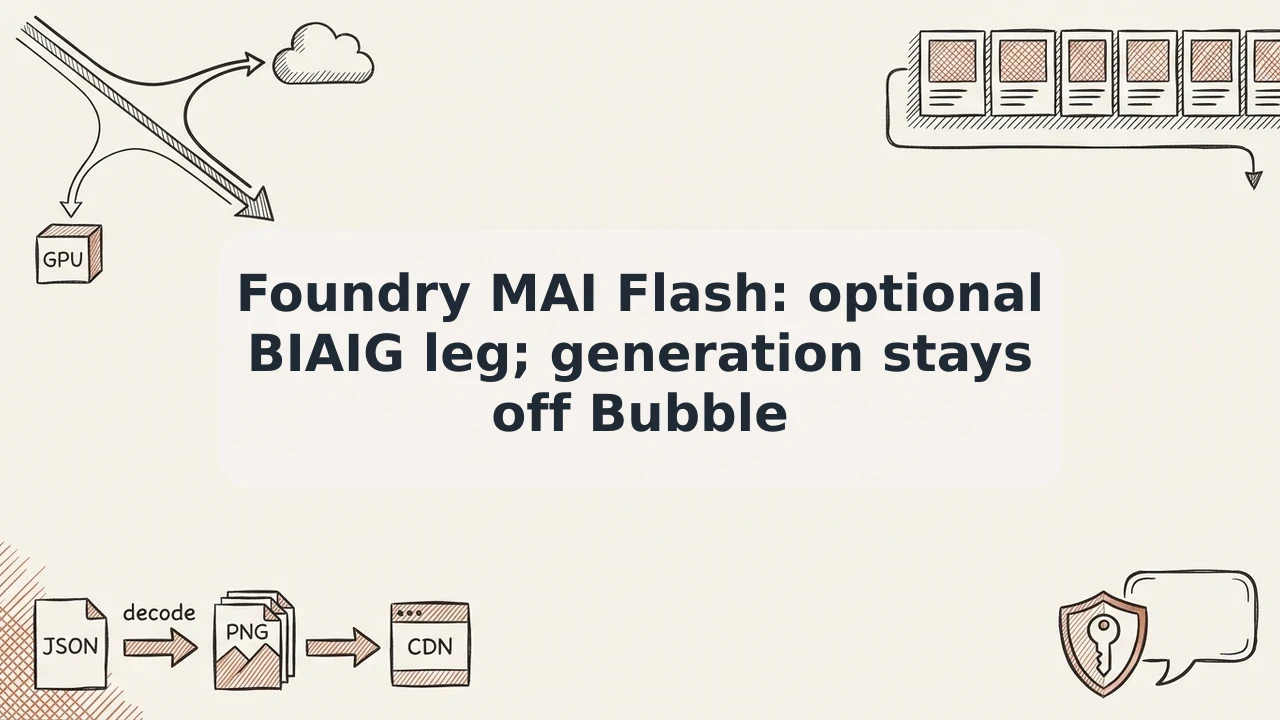
data[].b64_json)—decode, resize/CDN, then Bubble file fields. - 2.6 vs Flash: 2.6 for precision (complex edits, text rendering, campaign assets); Flash for rapid iteration, personalization, and high-volume generation.
- 2.6 family: up to five reference images on edits,
auto_aspect_ratio, optionalweb_grounding(Bing); ~2.36M pixel budget (~1.5K-class compositions). - Published token pricing (GA blog): 2.6 at $5/$8/$38; Flash at $1.75/$2.50/$19 per million tokens (text / image input / image output).
- Throughput: default Global Standard RPM is low (e.g. tier 1: 6 RPM; tier 6: 36 RPM for 2.6/Flash); quota-increase forms exist.
- Batch: in reviewed Microsoft docs, MAI Image does not appear in Global Batch lists the way Azure OpenAI text/multimodal batch does—do not assume 50% batch pricing or ~24h async without model-specific confirmation.
- Governance: data-privacy documentation covers training/opt-out and Global vs regional processing; default guardrails apply. Same topic: MOSS-Image (Apache-2.0, JSON layout): layout-driven.
Honest uncertainty: at research time, Learn’s MAI Image how-to could still show Preview / non-production SLA language while GA was announced on Tech Community. I reconcile portal, catalog, and Learn before I claim enterprise SLA—you should too.
The “extra leg + license/fallback” pattern
Same frame as the self-hosted Fibo and sync/async/batch matrix briefs:
- Leg — one provider with explicit contract (credentials, quota, output shape).
- License boundary — who hosts, who bills, model supplemental terms.
- Fallback — BIAIG switches on 429, content filter, timeout, or SKU policy (hero vs bulk).
In my setup Foundry is a fourth/fifth route, not a replacement orchestrator.
License / hosting boundary
| Dimension | Self-hosted bulk leg | Foundry MAI Image |
|---|---|---|
| Weights | Your infra / license | Microsoft-managed |
| Spend | GPU + license | Azure consumption |
| Secrets | Your middleware | Entra / API keys in Azure |
| Scale | Your queue + GPUs | RPM-capped sync API |
Enterprises often take Foundry because it rides the existing Azure agreement. I have seen smaller Bubble shops where deployment governance weighed more than Flash’s headline token rates.
When to wire into BIAIG fallback
I route Flash for bulk SKUs when:
- rows do not need heavy in-image text or multi-reference hero edits;
- after my per-SKU token math, Flash beats other legs at acceptable latency;
- middleware already decodes base64, stores assets, and passes URLs into Bubble (API connector or backend workflow).
I reserve 2.6 for catalog rows with:
- text-on-image and campaign-style layouts;
- image-to-image with multiple references;
- quality requirements where Flash increases rework.
Orchestration requirements:
- Retry/backoff on 429—never “fire one Bubble API call per repeater cell” at catalog scale.
- Red-team prompts (brands, people, edgy product copy)—guardrails create fallback noise.
web_grounding: Microsoft recommends human review when factual/brand accuracy matters—risky for unattended catalogs and for reproducibility.
When to keep closed SaaS before Bubble ingest
I keep tools like BulkImagen or Batch Banana (or my own worker) upstream of Bubble when:
- the Bubble app must not hold Azure secrets;
- I want to outsource queue and RPM orchestration instead of building middleware around 6–36 RPM defaults;
- I prefer one vendor UI/billing over Foundry deployment plus quota workflows;
- strict data residency conflicts with Global Standard cross-geo processing until Data Zone/regional options are confirmed for MAI Image in my region.
Bubble then owns ingest and catalog state—URLs, metadata, batch status—not raw generation secrets.
Sync/async at catalog scale
MAI Image is documented as synchronous generations/edits. For hundreds or thousands of SKUs I do not rely on sync alone:
- add async queuing in middleware or scheduled backend workflows;
- do not treat the RepeatingGroup as a parallel API fan-out;
- do not map OpenAI Global Batch economics onto MAI Image without explicit model support.
Foundry here is sync + queue, not “native batch API.”
Pre-production checklist
- Reconcile GA vs Preview labels and SLA in Learn/catalog.
- Compute $/SKU for Flash vs 2.6 vs existing BIAIG legs (your metering).
- Plan quota increases or load-test within default RPM tiers.
- Pipeline: base64 → PNG → resize → CDN → Bubble file field.
- BIAIG rules: SKU tag → primary leg → ordered fallback (e.g. Flash → Gemini → GPT → skip row).
- Log filter blocks separately from 429—otherwise fallback masks the wrong failure mode.
- Legal: Foundry agreement plus model-specific supplemental terms for commercial use of outputs.

| Checklist item | What to do | Pitfall / scope |
|---|---|---|
| GA vs Preview | Reconcile GA vs Preview labels and SLA in Learn/catalog | |
| Metering & quota | Compute $/SKU for Flash vs 2.6 vs existing BIAIG legs (your metering); plan quota increases or load-test within default RPM tiers | |
| Image pipeline | Pipeline: base64 → PNG → resize → CDN → Bubble file field | |
| BIAIG routing | BIAIG rules: SKU tag → primary leg → ordered fallback (e.g. Flash → Gemini → GPT → skip row) | |
| Error logging | Log filter blocks separately from 429 | Otherwise fallback masks the wrong failure mode |
| Legal | Foundry agreement plus model-specific supplemental terms | Commercial use of outputs |
What I do with this GA
MAI Image 2.6 / Flash GA in Foundry is an optional enterprise bulk leg for Bubble catalogs when Azure is already in my boundary and BIAIG can manage low-RPM sync routes. It is not a self-hosted cheap-GPU bulk path and not an automatic replacement for closed SaaS when secrets, queuing, or residency must stay off Bubble. I use Flash in volume routing, 2.6 in hero/edit lanes, and I treat production SLA as confirmed only when Microsoft’s docs match the GA announcement. A closer look: Bria Fibo 2.0 (8B, NC):.
Sources: Scout packet (Tech Community GA 2026-10-27, Microsoft Learn MAI Image, batch, privacy, guardrails; internal BIAIG / Fibo / sync-async briefs). No public documentation was found in the packet for Bubble-specific BIAIG wiring—orchestration is described as internal methodology. Worth reading next: FLUX 3 Image and Vercel.